
Before the Barbecue: Black Charlestonians and the First Decoration Day

A lot of us wake up on Memorial Day thinking about plans.
The extra day off. The drive to the lake. The grill that’s finally coming out of hibernation. The inbox quietly filling with “Memorial Day Sale!” in all caps.
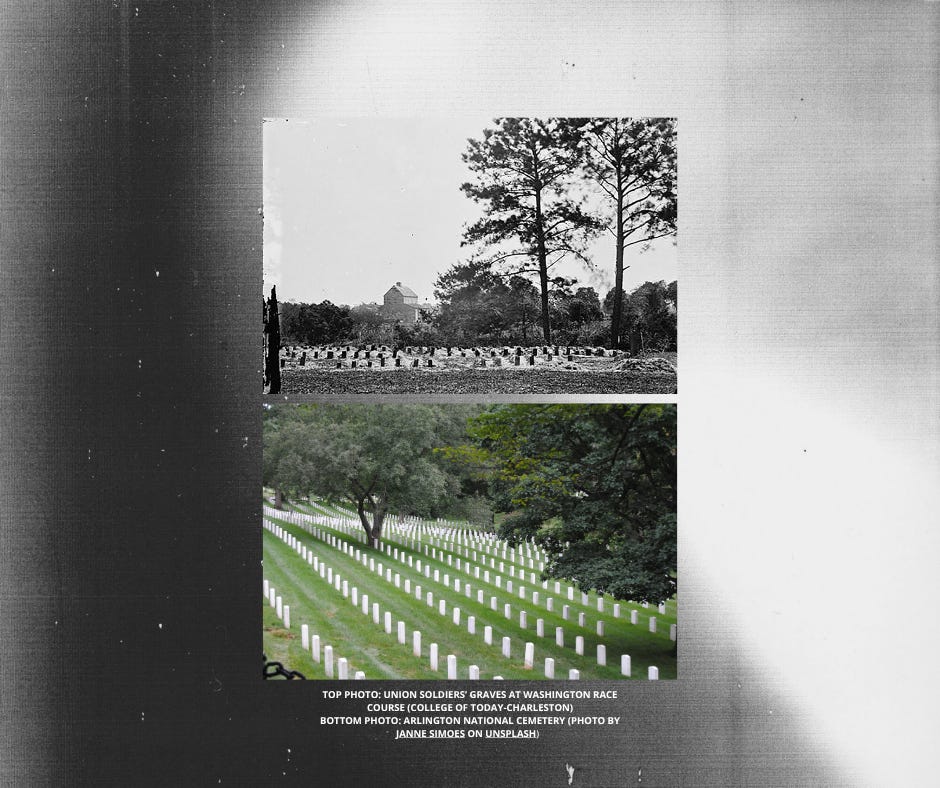
What most of us don’t wake up thinking about is a dusty racetrack in Charleston, South Carolina, in the spring of 1865, just weeks after the Civil War ended, where newly freed Black people were digging into the earth to pull strangers out of a mass grave.
I keep coming back to that image this morning.
A racetrack turned graveyard
The Washington Race Course used to be a playground for the wealthy, an elite track where Charleston’s planter class came to watch horses run and bet on whose animal would bring in the most glory. During the war, Confederate forces turned that same space into an open‑air prison for captured Union soldiers.
Some of those men never made it home.
They died inside that racetrack, and their bodies were shoveled into a trench, a mass grave dug not out of reverence, but out of convenience.
When the war ended and the Confederates fled, they left that trench behind.
What they did not expect was that the people they had once enslaved would decide that those anonymous Union dead deserved names, dignity, and flowers.
Freed people, sacred work
On May 1, 1865, formerly enslaved Black Charlestonians walked back onto that racetrack with a different mission. They were no longer property. They were no longer legally owned. And they chose to spend their new freedom digging.
They exhumed the bodies from the mass grave.
They reburied about 257 Union soldiers in individual graves, each one given its own place in the earth. They built a simple fence around the new cemetery, a fragile wooden boundary that said, “This ground is holy now.”
Above the entrance, they hung a sign with a phrase that still hits like a drumbeat:
“Martyrs of the Race Course.”
I imagine the care in those hands.
Hands that had tied rope, picked cotton, scrubbed floors. Hands that now nailed boards into a fence that was not for their masters’ horses, but for their own dead and for the dead of the army that had helped crack slavery open.
A procession of ten thousand
And then they did something even more radical: they filled that space with song.
On that new cemetery ground, an estimated 10,000 people, mostly Black Charlestonians, gathered. About 3,000 schoolchildren carried flowers and walked in a procession around the track, singing and scattering petals over the graves.
Think about that:
Children who might have been born into bondage now walking freely, arms full of blossoms, honoring soldiers they never met.
Women and men who had been whipped, sold, and starved now standing in the open air, listening to speeches and prayers, claiming the right to mourn publicly.
They held a full ceremony, sermons, prayers, hymns, and a picnic afterward. They did what Black communities have always done: turned grief into ritual, into gathering, into a declaration that these lives, these bodies, these stories matter.
They decorated the graves with flowers.
Decoration Day.
The version we were handed
If you grew up, like I did, learning that Memorial Day began in 1868 when a Union general named John A. Logan called for a national day to decorate soldiers’ graves, that story isn’t entirely wrong. But it is incomplete.
Logan’s order standardized a date, May 30, and gave white America a formal, national ritual they were ready to acknowledge. In the years that followed, different towns competed to claim the title “birthplace of Memorial Day,” each telling its own version of where the holiday truly began.
Somewhere in that contest, Charleston’s Black freedpeople, those who turned a Confederate racetrack into a cemetery and staged a ten‑thousand‑person ceremony, fell out of the official story. Their Decoration Day became a footnote, then an omission.
It took historians, digging through archives and diaries more than a century later, to bring the story back into the light.
What it means to remember
I keep thinking about the difference between memory that’s convenient and memory that’s true.
Convenient memory lets us skip straight to the barbecue.
It gives us a long weekend, a flag, a vague sense that “people died for our freedom,” and not much else.
True memory is messier. It requires us to admit that the people who did the earliest work of honoring the Union dead were Black, formerly enslaved, and very aware of what that sacrifice meant for their own lives.
On that first Decoration Day in Charleston, the line between “we are free” and “we remember” was not abstract.
They were honoring those who had fought and died in a war that cracked open the possibility of their own freedom.
They were also asserting something more: that they had the right to define sacred space, to name martyrs, to claim public rituals in a country that had just finished waging war over whether they were fully human.
That’s a different kind of patriotism than the one that shows up in commercials.
It’s not cheap. It’s not tidy.
From Charleston to every cemetery
Over the decades, Decoration Day widened. What began with Civil War dead grew to include Americans lost in World War I and II, Korea, Vietnam, and every conflict since. The name shifted from Decoration Day to Memorial Day, and the date eventually moved to the last Monday in May. But the core ritual, the act of going to a grave, saying a name, leaving a flower, never really changed.
Today, families stand on hot grass at national cemeteries and small-town plots alike, reading names etched into white stone. Some carry folded flags home, or sit in traffic trying to get to the one place their loved one’s name is carved in granite. Others light candles at kitchen tables because there’s no headstone nearby. For them, this is not just a “three‑day weekend”; it’s the day their loss is finally centered.
When I think about those Black Charlestonians at the racetrack, I don’t see their story as separate from these families; I see it as the root system. They were some of the first to say, in public, that the dead of war deserve remembrance, dignity, and ritual. Every wreath laid at Arlington, every flag planted on a grave, every quiet moment at 3 p.m. during the National Moment of Remembrance carries a little echo of that first insistence: these lives will not vanish into a trench.
Before and beside the barbecue
So as I sit here on Memorial Day, scrolling past photos of coolers and boat launches, my mind is in two places at once.
It’s on that racetrack in Charleston, where freed people dug into the earth to pull strangers out of a mass grave and renamed the ground itself. And it’s on every fresh headstone at Arlington, every older marker in a rural cemetery, every set of initials on a wall that someone will trace with their fingers today.
Before the barbecue, before the traffic, before the sales, there was a Decoration Day made by Black hands. And beside the barbecue, in the middle of the traffic, underneath the sales, there are still people whose hearts live at a gravesite on this Monday in May.
If Memorial Day is going to mean anything worth keeping, maybe it has to hold both truths at once: that Black Charlestonians helped teach this country how to honor its war dead, and that every generation since has added its own names, its own losses, its own flowers to the field.
Today, if you can, make a little space for all of them, the soldiers in that Charleston trench, the ones who fell in later wars, and the families who still carry their absence. Learn a story you weren’t taught. Say a name you do know. Let the day be more than a sale, more than a burger, more even than a flag. Let it be a memory that reaches all the way back to that racetrack, and all the way forward to the people standing at graves right now.