
House Judiciary Hearing: DHS Secretary Kristi Noem

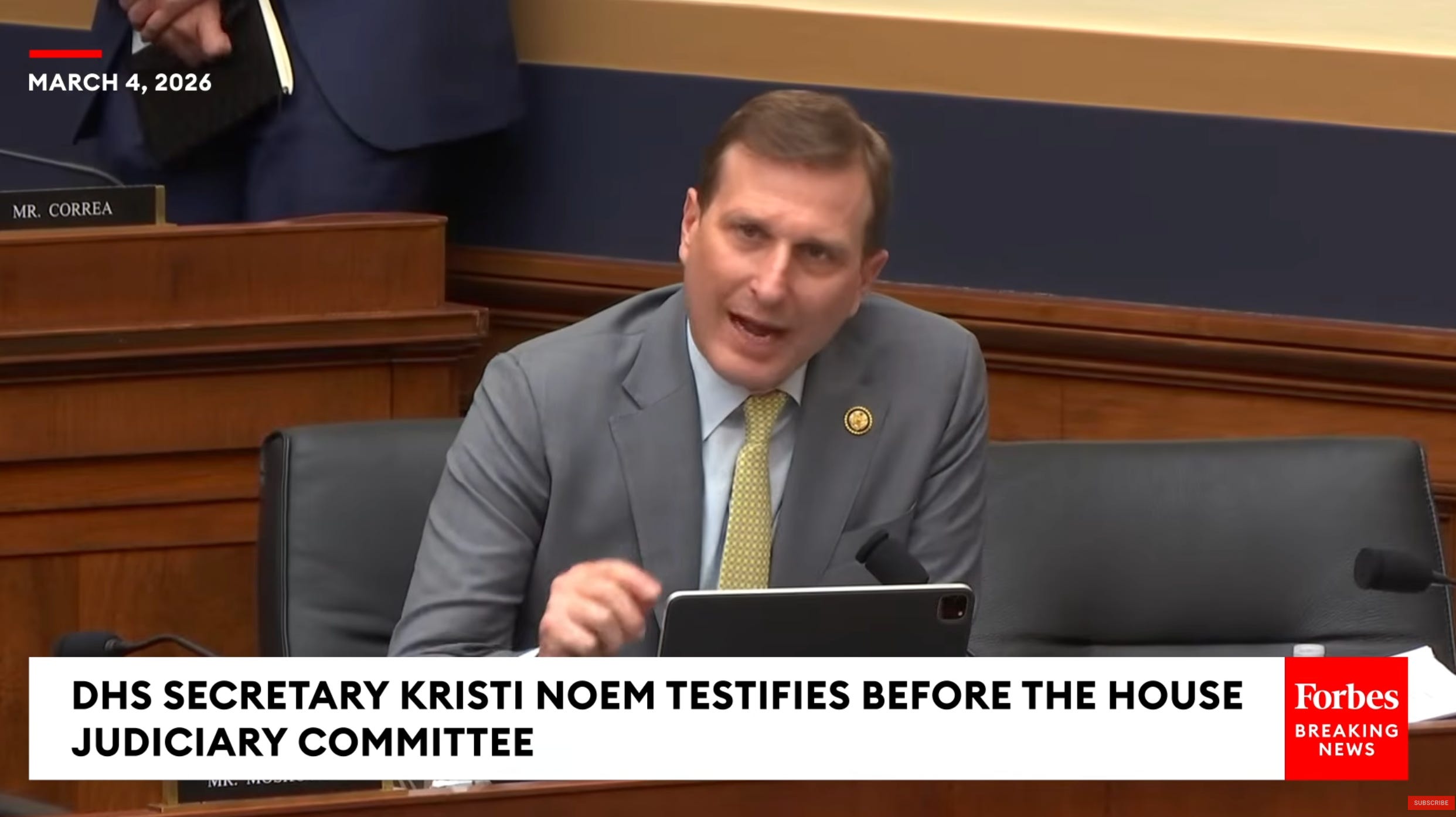
Yesterday, members of the United States House Committee on the Judiciary questioned Secretary of Homeland Security Kristi Noem during a hearing focused on immigration enforcement, departmental oversight, and the exercise of executive authority within the United States Department of Homeland Security.
Oversight hearings are one of the primary mechanisms Congress has to question how federal agencies are carrying out the laws they are tasked with enforcing.
Like the Senate hearing held earlier this week, the exchanges ranged from policy disagreements to broader questions about transparency and accountability inside the department, and a few questions that alluded to the reports of Secretary Noem's alleged affair with her subordinate.
Below are several moments from the hearing that stood out.
Clip 1: Goldman Presses Noem on Proposed Immigration Policy
Context
During questioning, Representative Dan Goldman challenged Secretary Kristi Noem about a proposed immigration-related policy and how the Department of Homeland Security would implement it.
Goldman repeatedly asked whether the policy had been formally proposed and how it would operate under existing law. Throughout the exchange, the congressman pressed for a direct answer regarding the department’s position and whether the proposal aligned with current legal authority.
The back-and-forth became one of the more pointed moments of the House Judiciary hearing.
Why This Matters
Hearings like this often focus on the gap between policy proposals, political messaging, and actual legal authority.
Members of Congress frequently use these sessions to clarify whether agencies are:
planning policy changes
acting under existing law
or interpreting their authority more broadly than Congress intended.
That clarification matters because immigration enforcement sits at the intersection of executive authority and congressional lawmaking, making oversight hearings one of the primary venues where those boundaries are tested.
Clip 2: Questions on DHS Enforcement Actions
Context
In another exchange during the hearing, lawmakers pressed Secretary Kristi Noem about the Department of Homeland Security’s current enforcement approach and the operational decisions being made by federal immigration authorities.
Members of the committee asked how certain enforcement actions were being conducted and whether those actions aligned with the legal authorities granted to DHS by Congress. The questioning focused on the department’s interpretation of its authority and how those policies are being carried out in practice.
As with several moments in the hearing, the discussion became a back-and-forth over how DHS is interpreting existing law and whether current enforcement strategies reflect congressional intent.
Why This Matters
Oversight hearings like this often focus on the space between what the law says and how an agency chooses to enforce it.
Congress writes the statutory framework for immigration enforcement, but executive agencies are responsible for implementing it on the ground. When members of Congress believe enforcement actions may be exceeding or misinterpreting that authority, hearings become the venue where those concerns are raised publicly.
Clip 3: Debate Over DHS Policy Direction
Context
Later in the hearing, lawmakers questioned the broader direction of DHS policy and the department’s priorities moving forward.
Members of the committee asked Secretary Kristi Noem to clarify how the department is balancing immigration enforcement, public safety concerns, and the legal obligations placed on DHS under existing federal law.
The exchange reflected the broader policy debate that often appears in congressional oversight hearings: whether current strategies reflect legislative intent or represent a shift in how the executive branch is exercising its authority.
-Note this one per usual with Congressman Moskowitz, gets…comical.
Why This Matters
The Department of Homeland Security sits at the center of some of the most contentious policy debates in the country, particularly around immigration enforcement.
Congressional hearings like this are designed to test how agencies are interpreting the laws they are responsible for enforcing. When lawmakers press for clarity on those interpretations, they are effectively examining the boundaries of executive authority.
That process, questioning, clarifying, and placing those exchanges into the public record, is one of the key mechanisms through which congressional oversight operates.
Final Thoughts
Congressional hearings are not always tidy or satisfying to watch. They can be contentious, repetitive, and sometimes frustrating.
But they remain one of the few public forums where executive officials must answer questions about how they are exercising the authority of their office.
As with the Senate hearing earlier this week, several members of Congress pressed Secretary Kristi Noem for direct answers regarding policy decisions, enforcement actions, and departmental priorities. It still seems like Secretary Noem doesn’t think she is going to be held accountable for the failures arising from her leadership.
Accountability is not a partisan concept. It is one of the mechanisms that helps maintain the balance between the branches of government. It needs to be upheld, or else we slip into constitutual crises territory.
I know he is pro life no matter what. No life saving measures, don't care if you're a 10 yr old graped by grandpa, you're having the baby. He also has no degree or experience. I believe he's an ex MMA fighter and has a temper. How he ever got a Senate seat is beyond me!!
Well, that went well. I am not impressed with the "placement" of her and her new replacement. It was trading the alligator for the crocodile.