
Pete Hegseth's Loyalty Problem:
Why “Serving at the Pleasure of the President” Should Terrify You

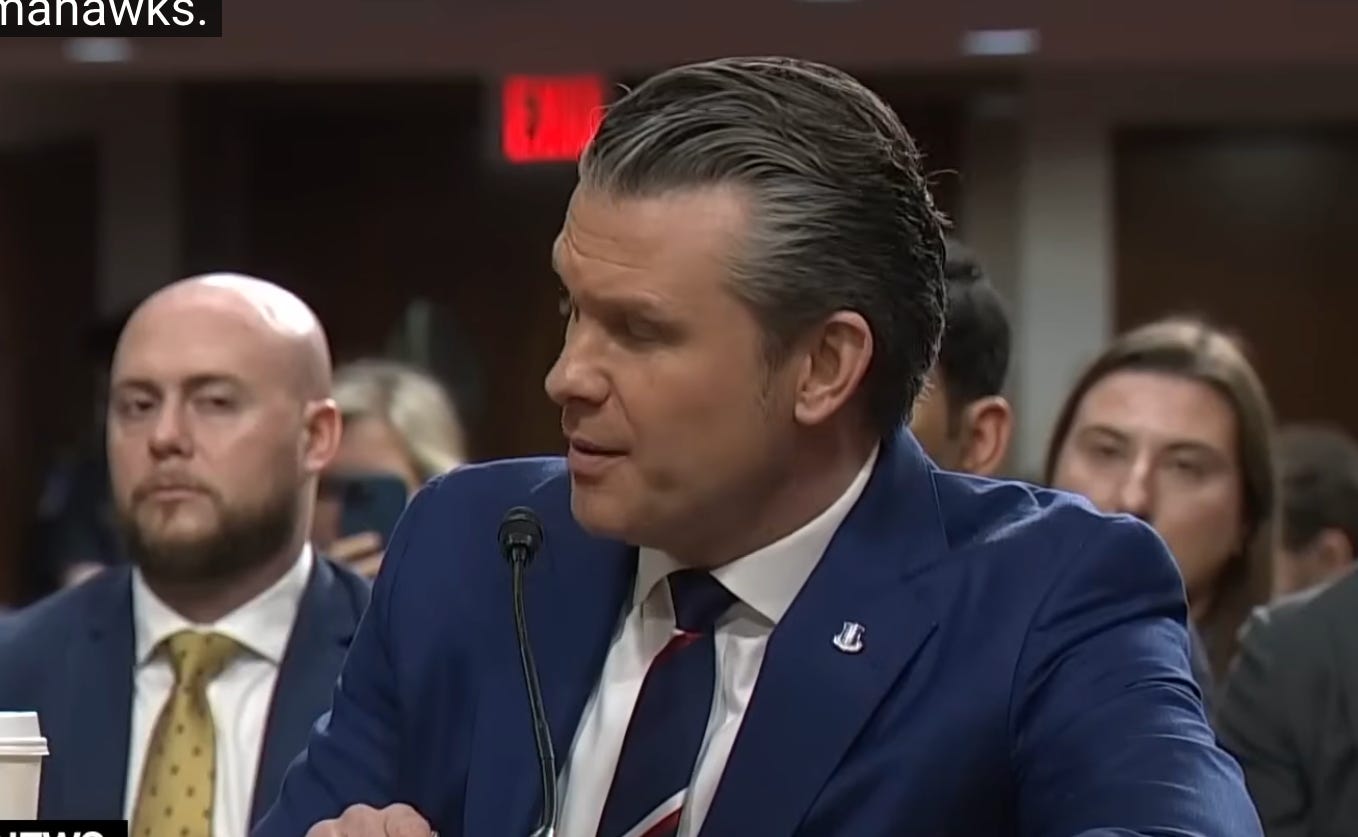
There are statements that sound routine until you stop and actually hear what is being said. Pete Hegseth repeating that he and others “serve at the pleasure of the president” is one of those statements.
That is not just a throwaway line about staffing. It reveals the governing philosophy of this administration: loyalty to Donald Trump comes first, while loyalty to the Constitution, to civilian oversight, and to the American people comes second (if at all).
And when that mindset is paired with control of the Pentagon, a widening war with Iran, open contempt for Congress, and a willingness to dismiss the testimony of U.S. troops, it stops sounding like standard personnel language and starts sounding like an authoritarian warning label.
The phrase that reveals everything
Pete Hegseth has now used that phrase in more than one context. In September 2025, while explaining why he had fired senior Pentagon officers, he told top brass, “We all serve at the pleasure of the president every single day.” In March 2026, after Kristi Noem’s ouster, he said it again: “We all serve at the pleasure of the president.” The repetition matters. This is not a slip. This is how he sees power.
That should alarm anyone who still believes public officials are supposed to serve the country rather than a single political leader. Yes, cabinet officials serve in an administration headed by the president. But a defense secretary is not the president’s personal courtier. The office carries enormous authority over war, military readiness, and the lives of service members. That authority is supposed to be exercised under constitutional limits and subject to congressional oversight.
Congress as the enemy
Hegseth’s recent testimony made clear how little respect he has for that oversight. Asked to defend the administration’s war with Iran, he did not treat Congress as a coequal branch doing its job. He treated lawmakers asking questions like enemies of the state. He said the “biggest adversary” the United States faces at this point is “the reckless naysayers and defeatist words of congressional Democrats and some Republicans.”
Read that again.
Not Iran. Not the cost of the war. Not the risk of escalation. Not the legal questions around war powers. According to the defense secretary, the real enemy is Americans in elected office asking whether this war is justified, lawful, effective, and worth the lives being spent on it.
That is the tell.
In Hegseth’s worldview, scrutiny is sabotage. Dissent is defeatism. Oversight is a weakness. Congress exists to applaud, not question. Once you understand that, his “serve at the pleasure of the president” line no longer sounds procedural. It sounds ideological. It sounds like the belief that the chain of command ends not with law, but with loyalty.
Dismissing the troops
That same attitude showed up when he was challenged on testimony from U.S. troops. During the hearing, Rep. Pat Ryan pressed Hegseth over accounts from soldiers who said they had been put in danger before an Iranian strike that killed six service members and wounded more than 20. Ryan asked if Hegseth was effectively saying those soldiers were lying. Hegseth did not answer with humility or concern. Instead, he lashed out, asking whether Ryan was just going to “monologue falsehoods.”
That exchange should have been politically fatal.
A defense secretary does not get to brush past the accounts of service members when their testimony contradicts the administration’s narrative. He does not get to hide behind swagger while grieving families and surviving troops are left with unanswered questions. And he certainly does not get to act as though the problem is the congressman asking the question rather than the six dead Americans at the center of it.
The nuclear contradiction
Then came one of the most revealing contradictions of all. In testimony, Hegseth suggested that Iran’s nuclear facilities had already been “obliterated.” But the administration had justified war by claiming Iran posed an imminent nuclear threat. Rep. Adam Smith immediately caught the contradiction: if the facilities had already been destroyed, why was a new war necessary on exactly those grounds? Hegseth had no coherent answer because there is not one.
This is what happens when propaganda replaces policy. The talking points only work until someone asks the next obvious question. Then the posture collapses and the aggression rises.
And that is what so many people are seeing in Hegseth: not strength, not discipline, not leadership, but insecurity wrapped in performative toughness. He acts less like a defense secretary accountable to the public and more like a political enforcer irritated that anyone expects answers.
The question he refused to answer
And then came the exchange that should have ended his tenure on the spot.
Senator Elissa Slotkin asked Hegseth a direct question: If President Trump orders him to seize ballots or voting machines during the 2026 midterm elections, will he refuse?
This was not a hypothetical designed to embarrass him. This was a question grounded in recent public statements by the president himself. In January 2026, Trump told the New York Times that he regretted not ordering the National Guard to seize voting machines in swing states after his 2020 loss. He said explicitly: “Well, I should have.”
Trump had actually had allies draft an executive order in December 2020 directing the secretary of defense to seize voting machines, but he did not sign it. Now, as president again, he has publicly stated he wishes he had gone through with it.
So Slotkin’s question was not a “gotcha.” It was asking the current defense secretary whether he would obey an unlawful order that the president has already said he regrets not giving the first time.
Hegseth refused to answer.
He dismissed the question as a “gotcha hypothetical,” even though Trump’s regret about not seizing machines is a matter of public record from just a few months ago. Slotkin pressed him again: “Your boss, the guy you’re performing for right now, told journalists this year that he wished he signed that executive order... what are you going to do? You’re the guy here in the seat. It’s not hypothetical. Tell the American people, will you deploy the uniformed military to our polls to collect voter rolls or machines?”
Hegseth still would not give a straight answer.
At one point, Slotkin, clearly frustrated, said: “Dude, just answer the question.” He did not.
Let that sink in. The United States defense secretary, under oath before Congress, would not commit to refusing an order to deploy troops to seize voting machines during a federal election. He would not say he would uphold the Constitution over the president’s stated desire to overturn election results by military force.
This is not about party. This is not about policy disagreements. This is about whether the person controlling the military will use that power to protect democratic processes or to subvert them. And Pete Hegseth, when given the chance to draw that line clearly, chose not to.
Because in his framework, the answer is already clear: he serves at the pleasure of the president. And if the president wants machines seized, ballots confiscated, and troops deployed to polling places, Hegseth has already told us what his guiding principle will be.
Not the Constitution. Not the law. Not democratic norms. The pleasure of Donald Trump.
What this reveals
The Department of Defense is not a campaign prop. It is not a cable‑news set. It is not a place for personal loyalty tests. It is the institution responsible for military force, national security, and the lives of the men and women ordered into danger. When the person at the top signals that loyalty to the president is the primary value, everything downstream is corrupted by that premise.
Military leaders begin to understand that truth matters less than obedience. Oversight becomes disloyalty. Bad news becomes career risk. Civilian deaths become unfortunate optics. Dead troops become “the consequence of conflict.” And the public is expected to clap on command while being told that asking questions helps the enemy.
That is not democratic accountability. That is how democratic accountability gets hollowed out from the inside.
And this is why the phrase matters so much. On its surface, “serve at the pleasure of the president” sounds like a bureaucratic truism. But in this administration, it is functioning as something else entirely: a loyalty oath in plain English. It is the worldview behind the firings, behind the contempt for Congress, behind the hostility to troop testimony, and behind the inability to separate the interests of the country from the ego of Donald Trump.
A serious defense secretary would understand that serving in a constitutional republic means accepting limits, questions, oversight, and accountability. A serious defense secretary would not frame members of Congress as the enemy for doing their jobs. A serious defense secretary would not repeatedly signal that his first allegiance is to the pleasure of one man.
The real problem
People should be alarmed by what Pete Hegseth said. They should be alarmed by how often he says it. They should be alarmed by how clearly his conduct backs it up. And they should be terrified that when asked directly whether he would deploy troops to seize voting machines if Trump ordered it, he refused to say no.
Because when the defense secretary sounds more committed to protecting the president from criticism than protecting elections from military interference, the problem is no longer just Pete Hegseth.
The problem is the kind of government this administration is trying to build.