
Senate Hearing: DHS Secretary Kristi Noem Faces Oversight Questions
Senate Judiciary Committee

Rather than summarize the hearing, I’m embedding several key exchanges so you can watch them directly and judge the moments for yourself.
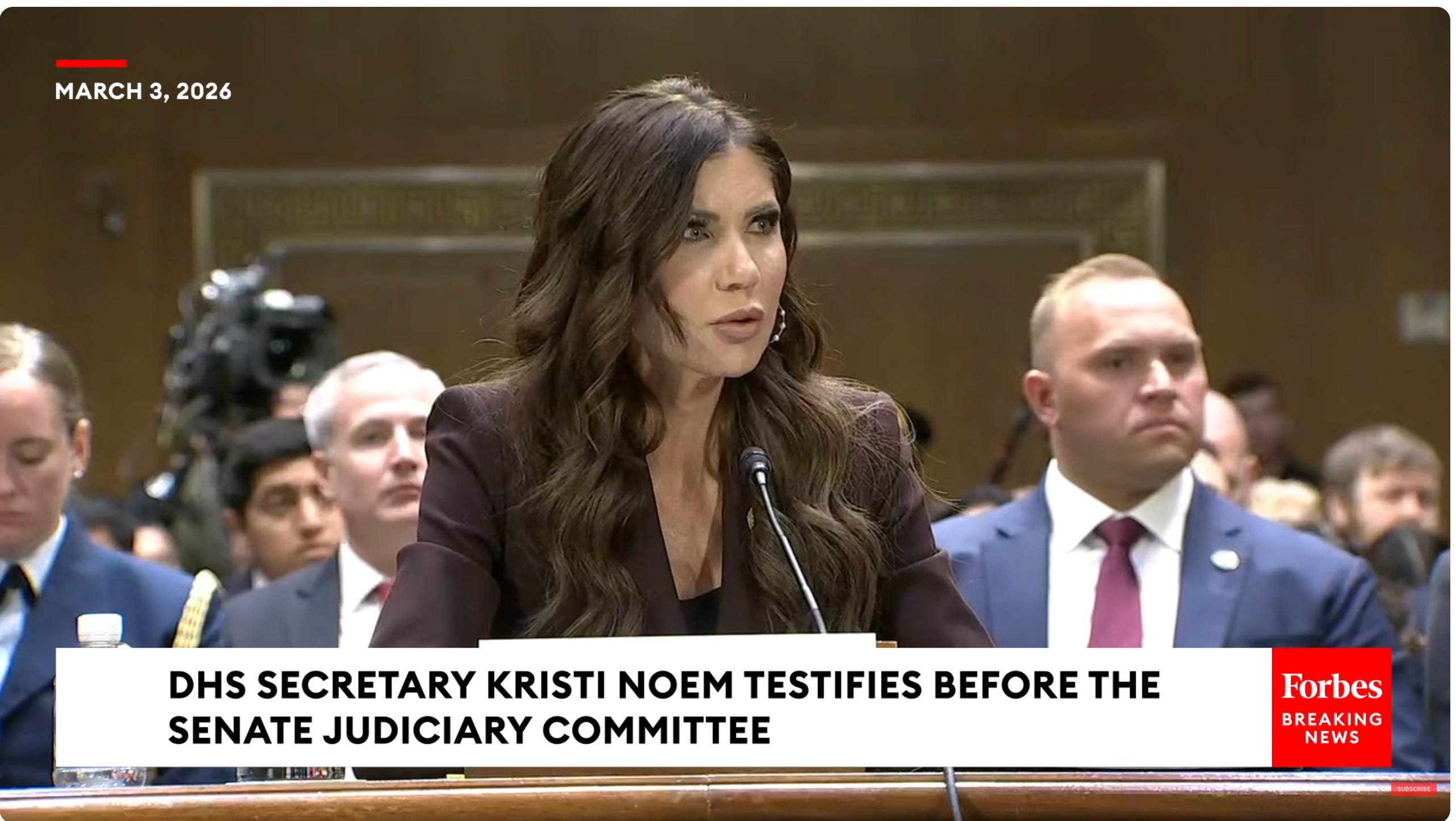
Secretary of Homeland Security Kristi Noem testifies before the Senate Judiciary Committee during an oversight hearing.
Congressional hearings can sometimes feel like political theater.
But every once in a while, a few exchanges reveal something important about how power is actually being used.
Below are several moments from the Senate hearing with Secretary of Homeland Security Kristi Noem that stood out.
Clip 1: Republican Senator Confronts DHS Secretary
Context
One of the most striking moments of the Senate Judiciary hearing came during an exchange between Senator Thom Tillis and Secretary of Homeland Security Kristi Noem.
During the exchange, Tillis openly called for Noem to resign from her position as Secretary of the United States Department of Homeland Security.
Tillis referenced passages from Noem’s recent book in which she described killing a dog that she considered untrainable and framed the decision as an example of the kind of difficult choices leaders sometimes have to make.
The senator argued that invoking that story as a leadership metaphor reflected poor judgment and raised concerns about her suitability to lead a major federal department.
The moment quickly became one of the most widely circulated exchanges from the hearing.
Why This Matters
Oversight hearings often follow predictable partisan lines.
What made this moment notable is that the call for resignation came from a member of the Secretary’s own party.
Whether one agrees with the criticism or not, exchanges like this illustrate something important about congressional oversight: it is one of the few public settings where executive officials can be directly challenged about their leadership, decisions, and judgment.
Those confrontations can be uncomfortable, but they are part of how accountability functions within the system.
Clip 2: Questions About DHS Spending and Advertising
Context
Later in the hearing, Senator John Kennedy questioned Secretary Kristi Noem about a Department of Homeland Security advertising campaign that reportedly cost roughly $220 million and prominently featured the Secretary herself.
Kennedy pressed the department on how that spending aligned with other budget concerns within DHS and asked whether the campaign was appropriate given its scale and visibility.
Noem defended the campaign, saying she had been directed to communicate the administration’s immigration policy and deterrence messaging internationally.
Why This Matters
Congress holds the constitutional authority over federal spending.
Hearings like this are one of the primary ways lawmakers question how taxpayer dollars are being used by executive agencies.
When large contracts, messaging campaigns, or procurement decisions raise questions, committee hearings become the forum where those decisions must be explained in public.
Clip 3: Questions About Immigration Enforcement in Minnesota
Context
Senator Amy Klobuchar questioned Noem about federal immigration enforcement operations in Minnesota, including the large number of federal agents deployed during recent enforcement actions.
The exchange also referenced the deaths of two U.S. citizens during immigration enforcement incidents earlier in the year, which had drawn significant criticism and prompted calls for accountability.
During the hearing, Noem defended the department’s actions and stated that the information she provided earlier about the incidents was based on reports coming from agents on the ground at the time.
Why This Matters
This line of questioning highlights the tension that often emerges between federal enforcement operations and congressional oversight.
Lawmakers frequently press agencies on:
how operations are conducted
what information was known at the time
whether earlier public statements were accurate
Those exchanges can be uncomfortable, but they serve a central purpose of oversight: ensuring that executive agencies are accountable for their decisions and public statements.
Final Thoughts
Hearings like this one with the Senate Judiciary Committee, are one of the few moments when executive officials are required to answer questions publicly about how they are exercising the authority of their office.
Throughout this hearing, Secretary Noem frequently appeared to avoid giving direct answers, at times redirecting questions or moving away from the substance of what was being asked.
That dynamic isn’t new to Washington, but it highlights why oversight exists in the first place.
Accountability is one of the mechanisms that keeps our constitutional system functioning. When Congress asks questions, the expectation should be clear answers, even when those answers may carry consequences for the people giving them.
Transparency in moments like these isn’t just good governance. It is part of how the balance of power envisioned in the Constitution is preserved.
The Constitution does not enforce itself. It depends on institutions willing to ask difficult questions, and leaders willing to answer them.