
The World Is Still Watching: Revisiting America’s Global Standing

Editor's note: This is a revised reflection on a piece I originally wrote in November. Time and distance clarified what mattered most.
Photo by MIKE STOLL on Unsplash
When we talk about what’s happening inside the United States, it’s natural to focus inward, on government dysfunction, economic anxiety, institutional strain, and the constant churn of political controversy. What’s easier to overlook is the external dimension of this moment.
The rest of the world is paying close attention.
When Trump returned to office in January 2025, international perceptions of the United States began shifting quickly. For much of the post–World War II era, the U.S. was seen as an imperfect but largely reliable actor, a stabilizing force that participated in global institutions, honored alliances (sometimes inconsistently), and broadly signaled commitment to democratic norms.
That perception has weakened.
Not because America has suddenly changed overnight, but because uncertainty has become its defining signal.
A Measurable Erosion of Trust
International polling over the past year reflects a consistent pattern: confidence in U.S. leadership has declined across much of the world. Surveys from organizations like the Pew Research Center show that in many allied nations, trust in America’s ability to manage global affairs has dropped sharply since early 2025. Pew Research Center
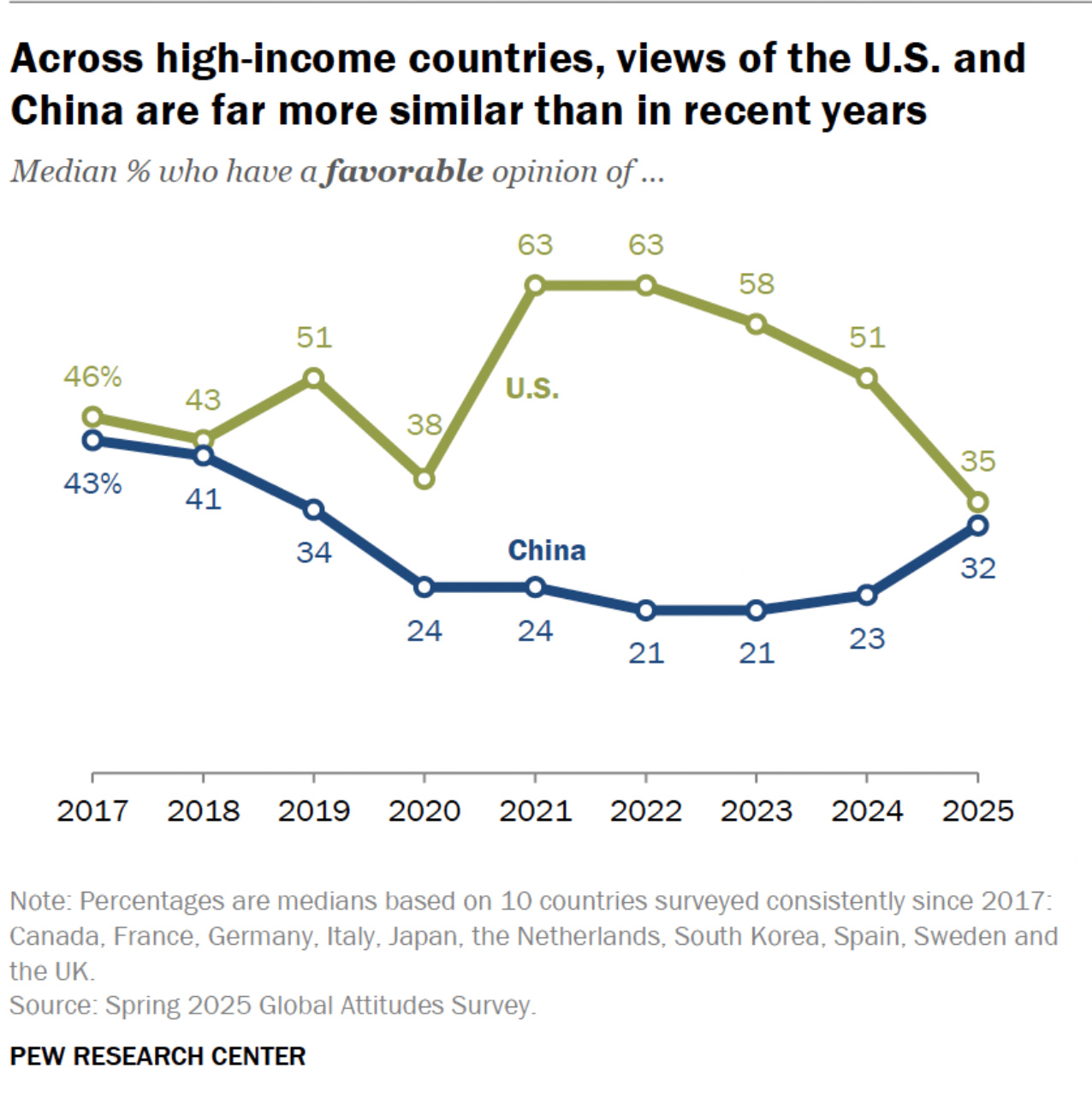
This isn’t simply about personal views of Donald Trump as an individual. It’s about what his leadership style represents to other governments: unpredictability, volatility, and frequent policy reversals.
For allies and partners, reliability matters as much as power.
Why Confidence Has Weakened
Across diplomatic, economic, and security circles, several concerns recur:
Policy unpredictability — abrupt shifts in foreign policy posture, inconsistent messaging, and public threats that create instability rather than deterrence.
Withdrawal from international commitments — including climate agreements, global health cooperation, and multilateral frameworks.
Economic uncertainty — tariffs, market instability, and fears about the downstream effects of U.S. economic turbulence.
Strained alliances — particularly within NATO and long-standing regional partnerships that rely on trust built over decades.
Taken together, these signals suggest a United States that is harder to plan around, a risky position for a country whose influence depends heavily on coordination and cooperation.
How Allies Are Responding
Public and private commentary from allied nations reflects a recalibration rather than a rupture.
European leaders increasingly speak of a “crisis of trust,” emphasizing contingency planning over assumption of U.S. leadership.
Asian partners are preparing for a reduced or less predictable American role in regional security.
Global health and climate organizations express concern about U.S. disengagement from collective efforts.
In practical terms, many countries are doing what rational actors do in uncertain environments: building backups.
A Necessary Nuance
It’s also true that Trump is not universally viewed negatively abroad. In some countries, particularly where populist or nationalist movements hold influence, his leadership style is seen as a challenge to institutions that those populations already distrust.
These pockets of support don’t negate the broader trend, but they do remind us that international reactions are shaped by domestic political contexts, not uniform global opinion.
The Larger Issue: A Globalized Identity Crisis
For much of the world, America’s internal struggles are no longer viewed as isolated domestic matters. Because of the U.S.’s economic size, military reach, and cultural influence, internal instability has external consequences.
When U.S. alliances weaken, global security becomes more fragile.
When climate commitments falter, global mitigation efforts suffer.
When democratic norms erode, authoritarian systems gain validation.
When the U.S. economy wobbles, markets everywhere respond.
America has always been a contradictory symbol, capable of harm and progress in equal measure. What’s different now is how visible its internal fractures have become on the world stage.
Why This Still Matters
It’s tempting to dismiss international opinion when domestic challenges feel overwhelming. But global perception directly affects:
economic stability
diplomatic leverage
national security
moral authority
long-term influence
Whether we like it or not, America’s choices ripple outward. And right now, many of those ripples are interpreted as signals of instability rather than leadership.
This isn’t about disliking America.
It’s about recognizing that credibility, once lost, is difficult to rebuild.
The world is still watching.
The more important question may be whether we are willing to watch ourselves with the same clarity.