
What If the Eptein Files Names Your President?

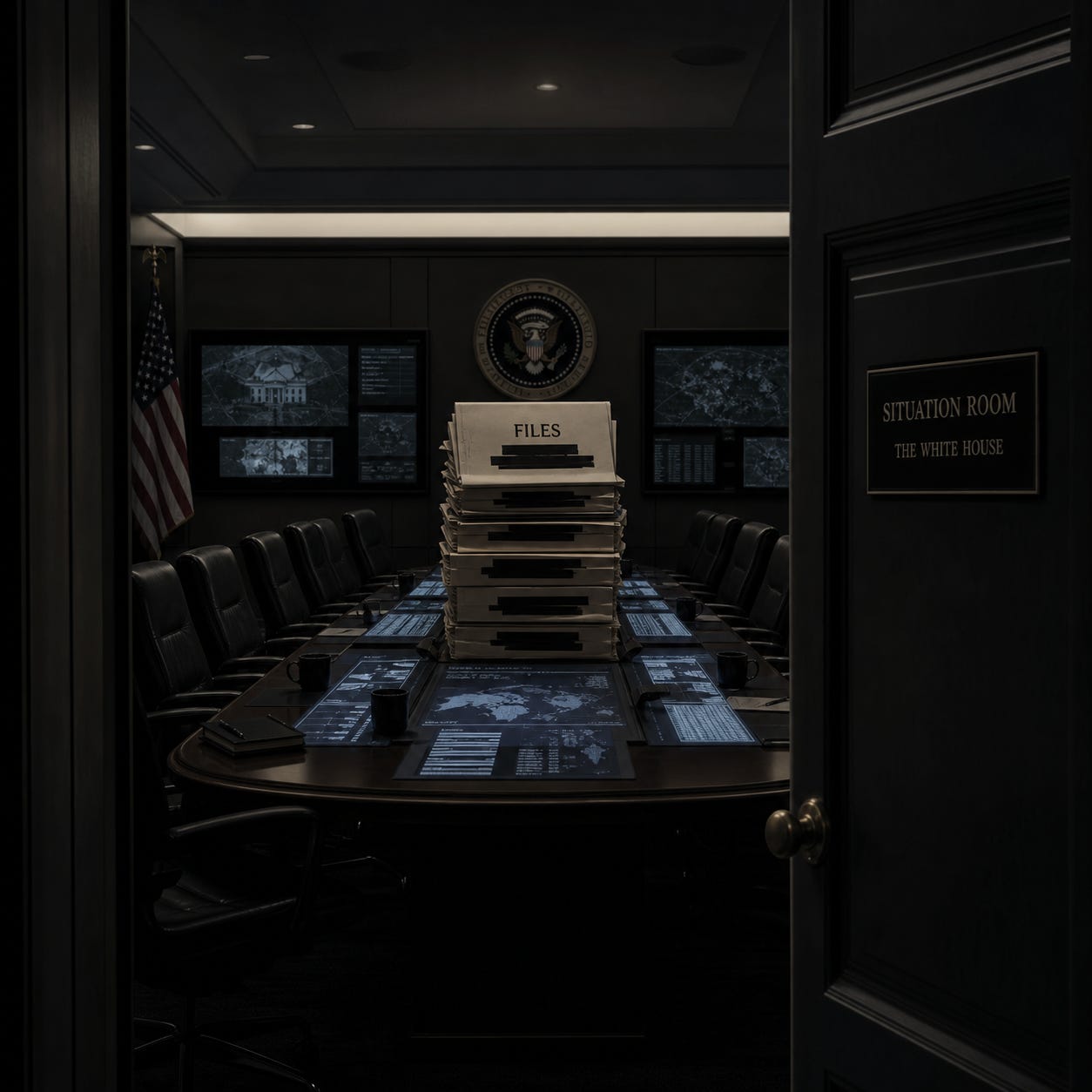
There’s a particular photo that lives in my brain when I think about the Situation Room.
You probably have it too: Obama and his team, eyes locked on a screen, watching the raid on Bin Laden’s compound. Whatever else you think about that chapter of history, the image is clear: this is where we deal with the worst‑case scenarios. This is where adults make decisions about life and death.
So imagine opening the New York Times and learning that under Donald Trump, that same room has been used as a crisis‑communications bunker because the president’s name keeps showing up in the Epstein files.
Not to figure out how to protect kids.
Not to figure out how to dismantle the network that enabled one of the most notorious sex traffickers of our time.
But to figure out how to protect him.
Because their boss is in the files, and they know the allegations attached to his name are not “oops, we sat at the same charity dinner once.” They are ugly. They are specific. They’re the kind of accusations that, if they were aimed at anyone else, we would not hesitate to call predatory.
And instead of asking, “What does this mean for the safety of the people he holds power over?” the question in the Situation Room became: “How do we make sure this doesn’t hurt him with the base?”
A president in the files
Let’s just say the quiet part out loud: Trump’s fingerprints are all over the Epstein story.
His name surfaces again and again in documents and testimony tied to a man whose entire business model was the sexual exploitation of girls. You don’t have to embellish anything; the public record already tells us he partied with Epstein, praised him as a “terrific guy,” and has been accused in sworn statements of conduct we’d never excuse from a teacher, a coach, or the guy who bags your groceries.
We are not talking about some random donor whose name slipped into a spreadsheet once. We are talking about the sitting president of the United States being threaded through the case files of a serial sex offender.
If that sentence doesn’t take your breath away, you’ve been desensitized on purpose.
Because here’s the thing: even if every single allegation against Trump somehow fails a criminal standard, no indictment, no conviction, the ethical bar is much lower than “beyond a reasonable doubt.” The question is not “can a jury be convinced?” The question is, “Is this someone we trust with enormous power over other people’s lives?”
And instead of trusting us with the full picture, his administration locked themselves in the Situation Room to make sure we didn’t see it.
The Situation Room as reputation shield
According to the reporting, Trump was furious about the Epstein files, but not in the way you might hope. He wasn’t angry that the justice system had failed survivors for decades. He wasn’t demanding that every last page be released so Americans could see exactly who did what.
He was angry that the files existed at all and that his name appeared in them.
So his top advisers did what they do best: they turned a moral crisis into a messaging problem. They gathered in repeated Situation Room meetings, without him, because even they understood his presence would make everything worse, and workshopped how to contain the damage.
Think about the symbolism here.
The room designed for nuclear crises, terrorist attacks, and real national emergencies was used as a staging area for helping a president manage the optics of being associated with a convicted sex trafficker.
They didn’t ask, “How fast can we release these documents so the public knows what we know?”
They asked, “How do we release just enough that we can claim transparency, without giving his critics ammunition or confirming his base’s worst suspicions?”
The priorities are crystal clear: protect the man, not the public.
Withholding the evidence from the people who hired him
Let’s talk about those files.
We know the Justice Department is sitting on millions of pages of Epstein‑related documents. We know they have been releasing them in carefully managed batches, heavily redacted, with timing and framing that seem designed to get ahead of public outrage rather than answer it.
Some of those documents include references to Donald Trump. Others involve powerful figures across government, finance, and media. The pattern is depressingly familiar: slow‑walk the releases, black out names, insist there’s “nothing to see here,” and hope we move on.
But in a democracy, that’s not their call.
If the person at the top of the executive branch appears in records tied to an industrial‑scale operation of sexual exploitation, that is no longer “internal DOJ business.” That is an urgent question for the electorate. We’re the boss. We’re the ones who are supposed to decide if we’re comfortable with a man in those files keeping his hands on the levers of power.
Instead, we’re being treated like children who can’t handle the truth.
Instead, the people whose reputations are on the line get meetings in the most secure room in the country, and we get press releases.
I don’t know how else to say this: if the evidence exonerates him, show us. If it doesn’t, why on earth should he remain president?
Normalizing the grotesque
One of the most effective tools of authoritarian politics is fatigue.
If you flood people with scandal after scandal, eventually they lose the ability to distinguish between “garden‑variety corruption” and “this should end careers.” Everything blurs into “oh, that’s just Trump being Trump.” The goal is to get you to a place where even the words “president” and “Epstein files” in the same sentence barely register.
But we cannot afford to normalize this.
We are talking about:
A president repeatedly named in sex‑crime files.
Survivors whose experiences are being redacted out of public view to protect the powerful.
A political operation that uses the Situation Room not to defend the vulnerable, but to defend the boss from accountability.
If we shrug and move on, we are saying, out loud, that this is an acceptable standard for the highest office in the land. We are saying that proximity to a serial abuser of girls is not disqualifying, as long as you have the right lawyers, the right spin, and the right allies inside the national security apparatus.
That should haunt us.
What we do with this
Here’s where I land, and you can decide if you’re with me.
I don’t want another heavily redacted PDF. I don’t want another solemn DOJ statement telling me “this has all been looked at.” I want full, unvarnished disclosure of every Epstein‑related file that mentions Donald Trump or any other senior official, with redactions limited to what’s absolutely necessary to protect survivors’ identities—not reputations in power suits.
I want Congress using its oversight power like it means something, not treating this as radioactive because it might upset the base. I want journalists and watchdogs to stop letting the administration set the pace of disclosure.
Most of all, I want us to stop gaslighting ourselves into thinking this is just how politics works now.
If the Situation Room has to be used, it should be used to protect children and democracy, not to protect a president from the truth about who he kept company with.
And if we look at the full record and decide we’re somehow still okay with that man in the Oval Office?
At least then it will be our decision.
Not the decision of the people hiding in the Situation Room.