

Every August, the headlines start warming up for election season. We hear a lot of claims about “great schools,” “failing schools,” and “parents taking back control.” But underneath the slogans, there’s a simple question most of us never get a straight answer to: where does my state actually rank on education compared to everyone else?
For State Scoreboard August, I’ve pulled together a 50‑state dataset from public sources that tries to answer that question with numbers, not vibes. Today is Day 1, and we’re starting with the education map, a national scoreboard of which states are investing in learning, and which ones are falling behind.
How this education scoreboard works
The education ranking I’m using is based on WalletHub’s 2026 “Most & Least Educated States” study, which in turn relies heavily on Census American Community Survey data.
WalletHub groups its metrics into two big buckets:
Educational attainment – the share of adults with high school, college, and advanced degrees.
Quality of education/attainment gap – school performance measures like test scores, graduation rates, and AP/NAEP results, plus some policy indicators.
They weight those into a 0–100 score and rank all 50 states, with rank 1 = most educated, rank 50 = least educated. I’ve taken those ranks, cleaned them up to a 50‑state list, and then lined them up with each state’s current political control and other system outcomes for this series.
Is this perfect? No. Any composite index involves judgment calls about which metrics matter more. But it’s directional and transparent: you can follow each number back to a public source and see how your state stacks up.
The Top 10 most educated states
When you sort the national education rankings, a very particular pattern pops out. The Top 10 most educated states are small to mid‑sized, higher‑income states that have spent a long time building out their education systems.
Here’s the Top 10:
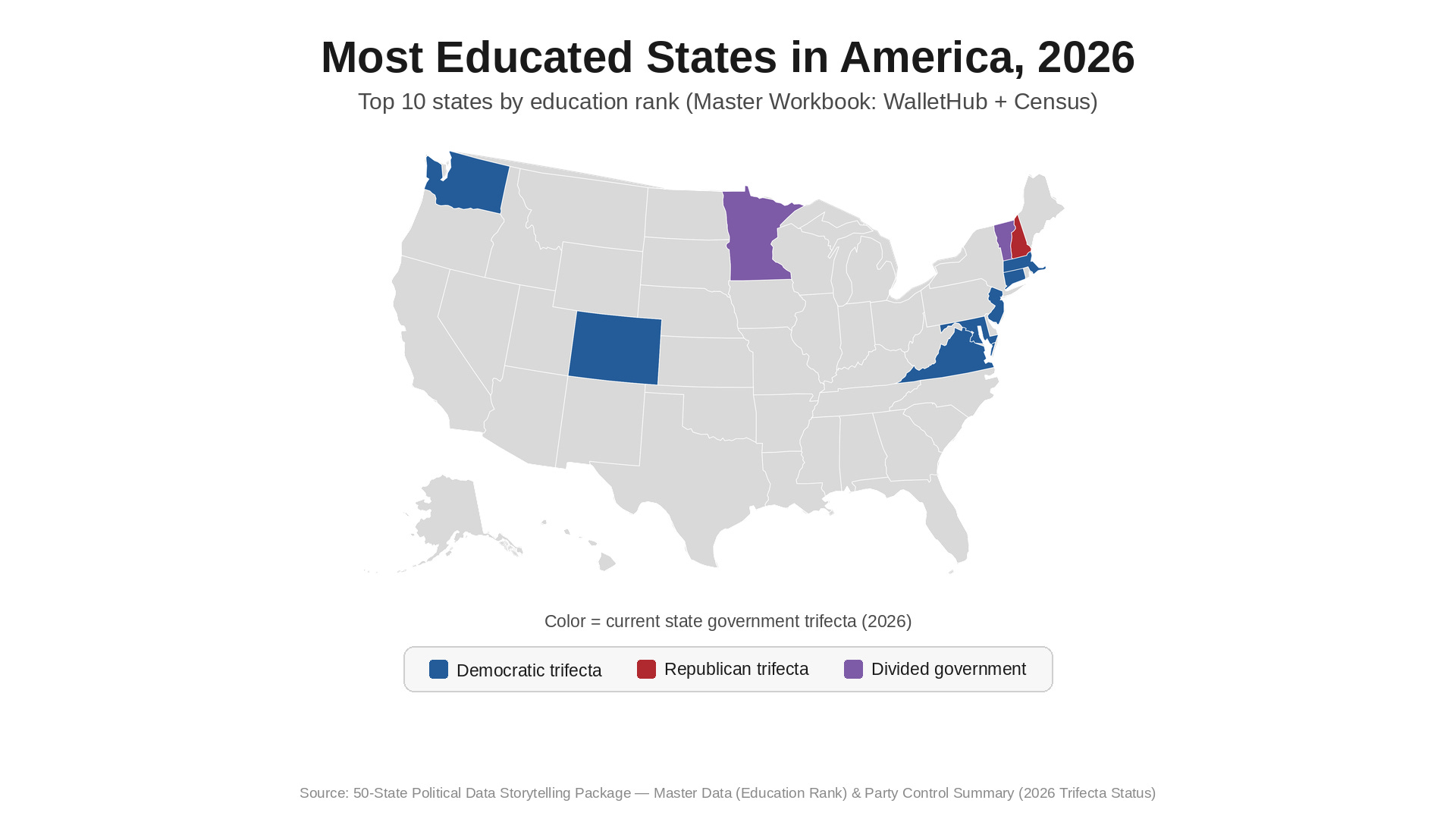
In the map graphic I’m using for this series, these states are highlighted by their current state‑government trifecta color: blue where Democrats hold the governorship and both chambers, red where Republicans do, and purple/gray for divided government.
This isn’t a “best state overall” list; it’s specifically about education. But it does tell you something important: if you grew up or are raising kids in one of these states, your education system is, statistically, giving you more tools to work with than many other places.
The Bottom 10 least educated states
Now for the harder part of the map.
At the bottom of the ranking, WalletHub finds a cluster of states with lower educational attainment and weaker school performance. In their 2026 list, the Bottom 10 (from 41–50) include a familiar group from the Deep South and Appalachia.
Here’s that Bottom 10 in the same format:
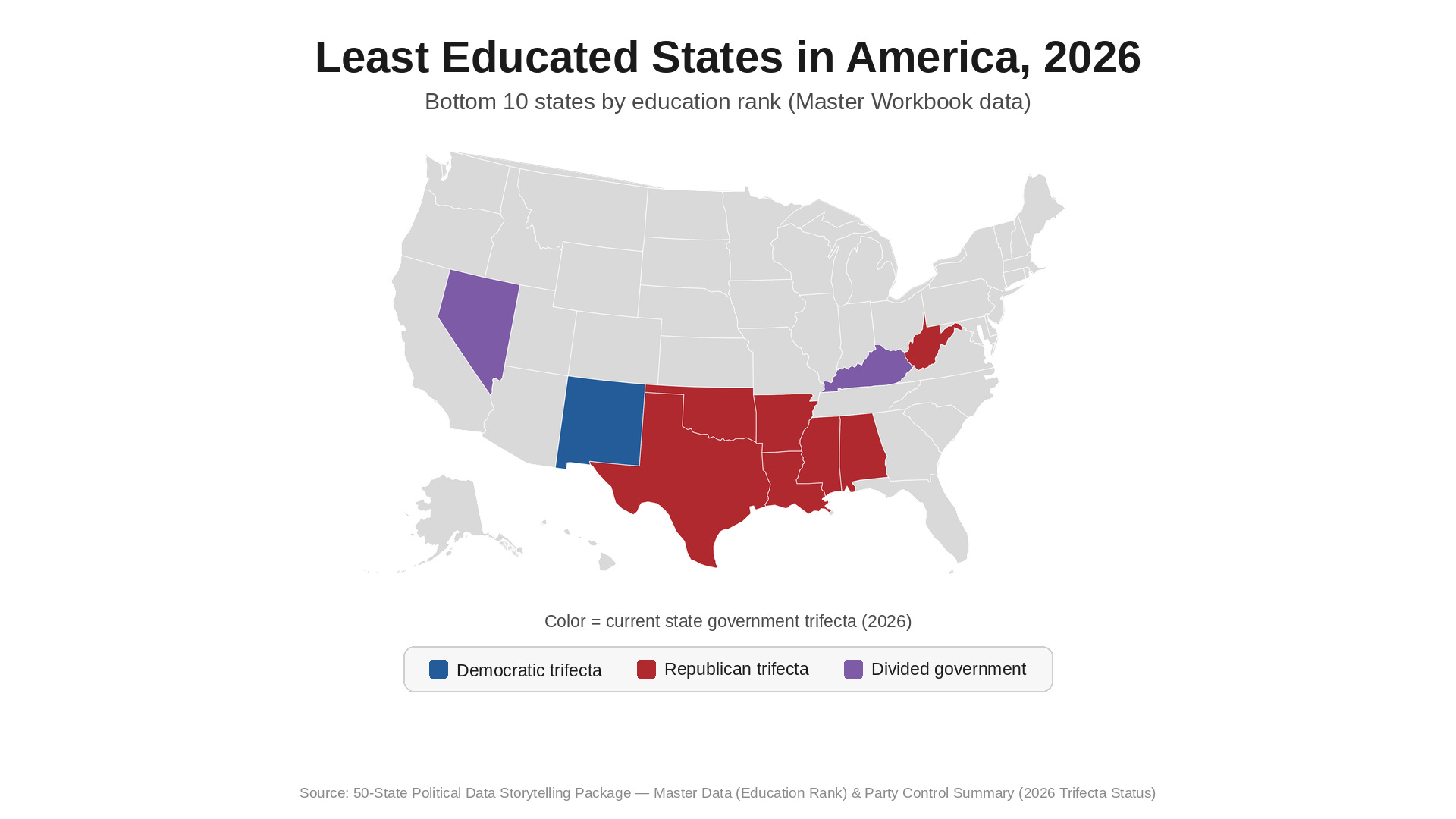
On the political map, many of these are states with long‑running one‑party control at the state level, often Republican trifectas that have been in place for most of the last two decades. A few are technically under divided government right now, but even those have years of single‑party legislative control behind them.
For people living there, this isn’t an abstract statistic. Lower education levels are tied to:
lower earning power and wealth over a lifetime
worse health outcomes
lower civic participation and weaker ability to navigate complex systems
When leaders in these states talk about “excellent schools” while the state sits in the mid‑40s or lower nationally, that gap between rhetoric and reality is part of the story State Scoreboard August is meant to surface.
Why start with education?
I’m starting this series with education for a reason.
Education outcomes sit underneath almost everything else we’re going to talk about this month: the economy, healthcare, even happiness. States with higher education levels often also rank higher on economic strength and health‑system performance, not because education magically fixes everything, but because it builds the workforce and tax base that make better systems possible.
Education is also one of the easiest places for politicians to spin. A few test‑score gains, a shiny new building, or a culture‑war headline about curriculum can distract from long‑term underinvestment. A national scoreboard forces us to zoom out and ask: compared to 49 other states, are we actually doing well? Or just doing better than we used to?
Where we’re going next
For Day 2 of State Scoreboard August, I’m going to stack this education map next to the economy: which states manage to be strong on both education and economic performance, and which ones are stuck in a pattern of low education and weak economies at the same time.
Later in the month, we’ll line these education rankings up with:
20 years of party control in each state, who has actually been in charge of these systems.
Healthcare, happiness, and even perceived “friendliness.”
The federal balance of payments, who pays more into Washington than they get back, and who depends heavily on federal money.
The goal isn’t to dunk on particular voters or communities. It’s to tell the truth about systems and power, so you can walk into the midterms with a clearer picture of how your state is really doing.
Your turn: where does your state land?
If you’re comfortable sharing, drop your state in the comments.
All month, I’ll be using this data to do short, state‑specific breakdowns: “Here’s where your state sits on education, economy, healthcare, and here’s who has held power over those systems for most of the last 20 years.”
Ranked, not ranted. Every number has a link. And in State Scoreboard August, the map belongs to all of us, not just the people in charge of it.


